
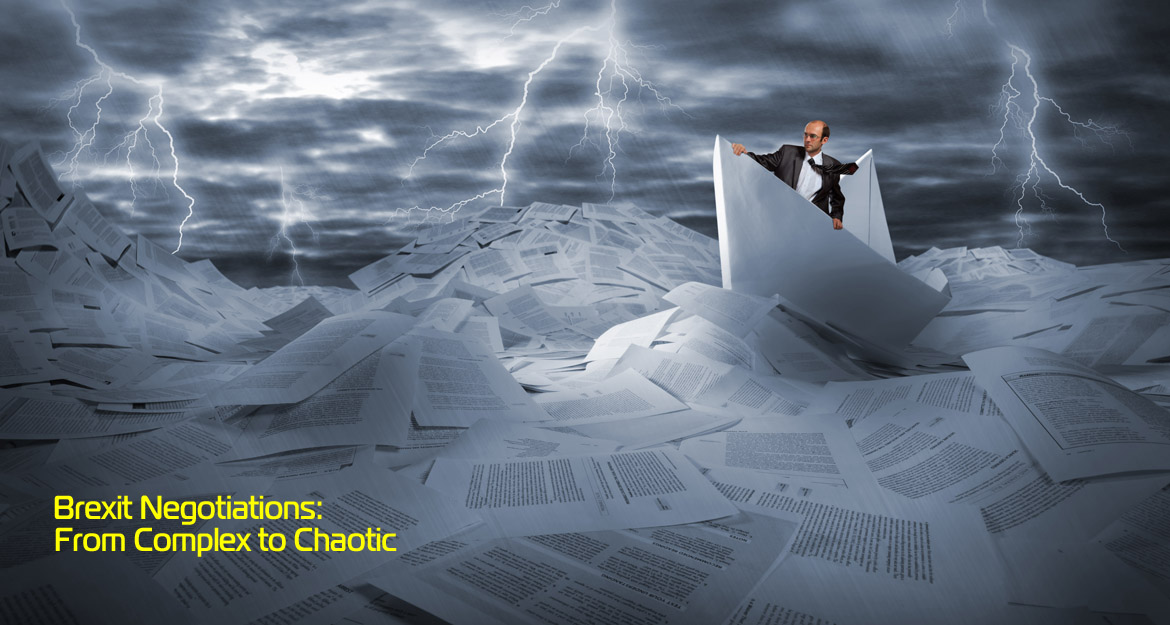
Crisis has fallen on the Brexit negotiations, once simply complex and now, since June 8th 2017, chaotic.
On that date, the United Kingdom (UK) election resulted in a hung parliament, where the Conservative Party has lost its majority. In terms of Brexit, the context has shifted from complex to chaotic – that is to say, the nature of decision making and process of reaching agreements within the negotiations is now unpredictable. Can the UK negotiate effectively with the European Union (EU) in just two years? What challenges do they face, and how has this shift to chaotic altered their chances of a preferable outcome?
During the pre-election stage, the Brexit negotiations already faced many difficult challenges. When the UK invoked Article 50 of the Treaty on the European Union, they entered negotiations to withdraw from the EU. The process imposes a two-year deadline to reach an agreement.
Negotiators loathe deadlines. Should there be one looming overhead, each party wants to be the only one who knows about it. At the very least, it’s preferable for both parties that the impact is equally felt on both sides so nobody has the advantage.
In this case, the situation is not of equal consequences. By invoking Article 50, the two-year Brexit clock began ticking, more in favour of the EU rather than the UK. It is a point of no return; should the parties not achieve a negotiated outcome within two years, they will have to default to the World Trade Organisation (WTO) rules, which is a potentially unfavourable outcome for the UK.
Now comes the June 8th UK election, shifting the Brexit negotiations from a complex domain to a chaotic domain – that is, crisis. Crisis is the domain of rapid response. At this point, the Prime Minster Theresa May’s immediate job is to establish order before leaping into negotiations.
When dealing with complex context, a domain of ‘unknown unknowns’ with unpredictability and no order, it is still possible to prepare for talks. While solutions can’t be imposed in complex contexts, a leader’s job is to create an environment for emerging patterns to find a negotiated outcome. This by itself is not an easy task to manage.
On the other hand, by shifting the negotiations to a chaotic domain, a realm of unknowables, the leader has to act quickly and take immediate actions to restore order. To have the best chance at these negotiations, the UK must do this quickly, and transform the situation from a chaotic domain back to a complex domain before sitting at the negotiating table with the EU. Leading in a crisis and managing turbulence times ahead will require a change of behaviour, and openness to adopt to new circumstances.
One question is, should Theresa May lead such negotiations? How quickly can she bring stability and move from a chaotic back to the complex domain before sitting at the negotiation table? Her vision, judgement, and decision to call an unnecessary early election have led to a hung parliament and a weakened position in Brexit.
Other key challenges facing Brexit negotiations involve the number of stakeholders involved, the number of topics that need to be negotiated within a very short period of time – 2 years from invoking article 50 – and potential issues around cherry-picking, which the EU will resist. From a negotiation perspective, the clock is ticking against the UK.
While some EU members ask for calm and rationality in negotiations, Brexit is already showing signs of a hostile negotiation. For example, the European Parliament’s chief Brexit negotiator vowed he won’t “go soft” on Britain during divorce talks, pledging to make the “UK’s loss, Europe’s gain”. In an extract from his new book, the former Belgian PM said the EU would be seen as a “doormat” if a tough deal was not struck.
It is a highly charged and emotional environment on both sides. They each want to “teach the other side a lesson”. For the EU, it is to make sure the outcome deters any other EU members from heading for the exit. The UK needs to show that by leaving the EU they will be better off; they cannot accept an exit outcome that shows them at a disadvantage. Both sides must conclude negotiations in a situation that shows the other in the less favourable position.
The early election has given rise to a new stakeholder in that the Conservatives now need the support of the Democratic Unionist Party (DUP) confidence and supply deal to form government. This adds an additional layer of complexity to an already complex negotiation. This new stakeholder may have differing objectives and positions, and it is now likely that the internal UK negotiations will be negotiations within negotiations.
On the other side for the EU negotiators, this new environment is unpredictable and less stable. Their perspective shows British negotiators in chaos with no cohesive message – they may even be puzzled by confusing messages from British negotiators reflecting conflicting objectives from the multiple British stakeholders.
The dilemma faced by the EU negotiators involves deciding whether they can rely on the agreements at each stage of negotiations with the British negotiators. Are they on solid ground? What guarantees do they have that British negotiators will not re-open an already closed topic and re-negotiate? This could make the negotiation process extremely exhausting.
Adding to all of that is another challenge for the UK, as the Norwegian Prime Minister Erna Solberg puts it: “Long membership of EU has left Britain without key skills for successful trade talks”. Indeed, the UK has already created setbacks for the negotiations that must be resolved within the two-year deadline. Defining a negotiation strategy, and managing all the challenges is a real task, even for the most experienced negotiators. Is Theresa May the right horse for the course?
Calling an early election was the wrong choice and plunged the Brexit negotiations into a chaotic domain. Does May have the skills to lead the UK in perhaps in one of its most critical periods of recent history?
Regardless of the Brexit negotiation outcome, one sure thing is that both the UK and the EU need to maintain a good relationship for life to go on in the interest of all parties. A wise outcome would involve a healthy resolution for both parties without involving the WTO and further setbacks. With less than two years left and challenges towering overhead, the United Kingdom has a long way to go.